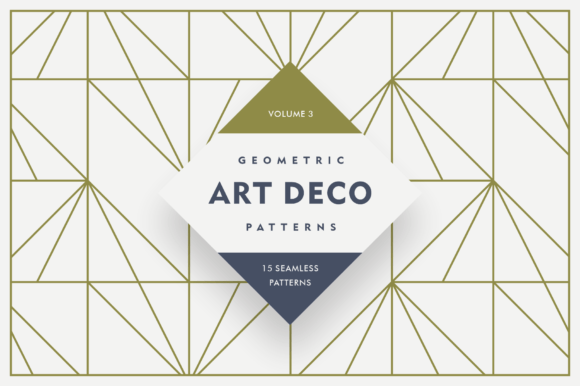
Geometric Art Deco Patterns V3
Geometric Art Deco Patterns V3 is a curated digital collection of 11 original, tileable pattern designs rooted in the visual language of early 20th-century Art Deco architecture. Each pattern emphasizes symmetry, repetition, angular geometry, and rhythmic line work—hallmarks of classic Deco aesthetics. Unlike generative or AI-assisted outputs, these patterns were manually crafted to reflect authentic architectural motifs: stepped forms, sunbursts, chevrons, zigzags, and stylized florals rendered with geometric discipline.
The collection is delivered as a unified package containing 15 pattern files—not 11—because it includes multiple versions of select core designs optimized for different technical needs: some patterns appear in alternate colorways or scale variations to broaden usability without compromising cohesion. All files are provided in three formats: vector AI (Adobe Illustrator), vector EPS (cross-compatible with older design software), and high-resolution JPG (3000×3000 px at 300 dpi). This format diversity supports both scalable vector workflows and raster-based print production.
Who Might Find Geometric Art Deco Patterns V3 Useful?
Designers working on branding, packaging, editorial layouts, or surface design may consider this collection when seeking historically grounded, repeatable motifs that convey sophistication and structure. Its emphasis on tiling and editability makes it relevant for projects requiring seamless backgrounds—such as website headers, presentation decks, textile mockups, or stationery systems. Because each pattern is built from vector paths, users can adjust colors, stroke weights, or proportions directly in Illustrator or compatible tools without quality loss.
It is especially suited for practitioners who value consistency across touchpoints: a single pattern can serve as a subtle background in a logo lockup, extend across a business card, and repeat across a fabric swatch—all while retaining fidelity and stylistic continuity. The architectural inspiration also lends itself well to sectors where authority and timelessness matter: finance, hospitality, luxury retail, and cultural institutions.
Key Benefits and Practical Considerations
One benefit is immediate usability: all patterns are pre-aligned and tested for seamless tiling. No additional trimming or offset adjustments are needed—a time-saver for designers managing tight deadlines. The inclusion of both AI and EPS files ensures compatibility across Adobe Creative Cloud versions and legacy environments, while the JPGs offer plug-and-play use in non-vector applications like Canva or Photoshop.
However, users should note limitations. The collection contains no Photoshop patterns (.pat), SVG, or Figma-ready assets—so teams relying exclusively on those platforms will need to convert or recreate elements. There are no layered source files (e.g., separated foreground/background groups), meaning complex edits—like isolating one motif within a multi-element pattern—may require manual path manipulation. Additionally, while the patterns are editable, they do not include parametric controls or smart objects; changes must be made using standard vector editing tools.
Color treatment is another consideration. The JPGs ship in RGB, and vectors default to process CMYK or RGB depending on the file—but no Pantone references or pre-built brand-color variants are included. Users integrating into strict brand guidelines will need to reassign swatches manually. Similarly, there is no documentation on recommended minimum repeat sizes or safe margins for large-format printing, so technical validation remains the user’s responsibility.
When Geometric Art Deco Patterns V3 Is a Strong Fit
This collection aligns well with projects where historical resonance, geometric precision, and production efficiency intersect. For example, a designer developing a boutique hotel’s visual identity might use one of the sunburst patterns as a subtle wallpaper texture in guest room stationery and carry the same rhythm into signage borders. Or a publisher launching a reissue of 1920s-era literature could apply a chevron motif across cover wraps, endpapers, and promotional banners—ensuring stylistic unity without licensing third-party assets.
It also suits users who already work within the Adobe ecosystem and prefer hand-crafted, intentional design over algorithmically generated alternatives. Because the patterns avoid overused tropes (e.g., generic “gold foil” textures or low-effort halftones), they support differentiation in crowded markets—provided the project context values restraint and architectural clarity over maximalism or trend-driven novelty.
When Alternatives May Be Worth Evaluating
If your workflow depends heavily on real-time collaboration in Figma or web-first design systems, you may find the absence of native component libraries or CSS-friendly exports limiting. In such cases, pattern generators with live-editing interfaces—or custom-built SVG tile sets—could provide more flexibility.
For projects requiring thematic variety beyond geometry—such as organic Art Deco motifs (stylized birds, fountains, or palm fronds) or period-accurate typography pairings—the collection’s focused scope may feel narrow. Similarly, if you need extensive color variants, animation-ready sequences, or accessibility-tested contrast ratios, supplemental resources would be necessary.
Cost and licensing are also practical factors. Geometric Art Deco Patterns V3 is distributed as a one-time purchase with standard commercial use rights, but it does not include extended licenses for resale in templates or SaaS platforms. Teams building white-label design tools or marketplaces should verify whether their intended usage falls within the license terms—or explore royalty-free stock platforms offering broader redistribution allowances.
Making an Informed Decision
To determine whether Geometric Art Deco Patterns V3 meets your needs, begin by auditing your current assets: do you already have usable Deco-style patterns, or are you starting from scratch? Next, map your output requirements—will you need vector scalability, print-ready resolution, or web-optimized raster files? If all three apply, the bundled formats here reduce format-conversion overhead.
Review the sample previews critically: look for alignment consistency at tile edges, clarity of line weight hierarchy, and adaptability to your brand’s color system. Try opening one AI file in your version of Illustrator to test responsiveness and layer organization. Finally, compare against alternatives—not just on price, but on long-term maintainability. A slightly more expensive set with better documentation or modular construction may save hours over repeated projects.
In summary, Geometric Art Deco Patterns V3 offers a focused, technically sound resource for designers prioritizing architectural authenticity, vector fidelity, and cross-format readiness. It is not a universal solution, but for specific contexts—especially branding, publishing, and surface design—it provides measurable utility grounded in deliberate craft rather than algorithmic convenience.