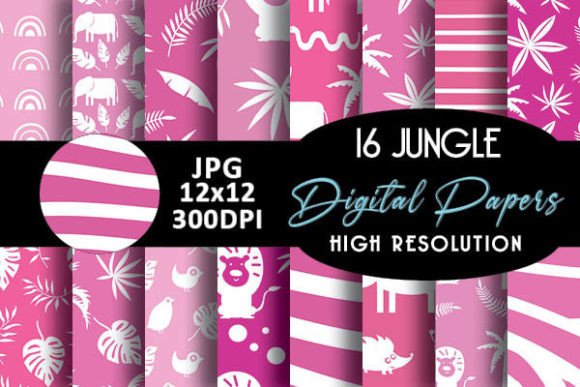
Pink Safari Digital Papers Patterns: A Creative Catalyst for Jungle-Themed Design Projects
Designers, educators, small business owners, and craft enthusiasts increasingly seek digital assets that balance aesthetic appeal with functional versatility. Among the most adaptable resources in this space are Pink Safari Digital Papers Patterns—a curated collection of 16 high-resolution Jungle Safari Premium Digital Papers designed to support diverse creative workflows. Unlike generic textures or overused stock backgrounds, these papers integrate intentional color psychology, botanical authenticity, and rhythmic pattern composition to serve both expressive and practical ends.
What Makes These Jungle Safari Digital Papers Distinctive?
The 16 Jungle Safari Premium Digital Papers stand apart not just in quantity, but in thoughtful curation. Each background features layered visual storytelling: subtle leaf veins, soft watercolor washes beneath geometric animal silhouettes, delicate fern motifs repeated with organic variation, and gradients that evoke dappled sunlight filtering through dense canopy. Crucially, the “pink” in Pink Safari Digital Papers Patterns is not a monolithic hue—it spans coral blush, dusty rose, muted magenta, and warm salmon tones, all carefully calibrated to complement earthy greens, ochres, and deep teals without clashing or overwhelming.
This chromatic harmony supports accessibility and inclusivity in design. For example, educators creating printable jungle-themed lesson plans find that the pink-green contrast meets WCAG 2.1 AA contrast ratios for body text overlays, while still retaining warmth and playfulness. Similarly, small business owners launching eco-conscious children’s apparel lines use these papers as base layers for packaging mockups—knowing the palette signals approachability and nature awareness simultaneously.
Educational Resource Development
In classrooms and homeschool settings, visual scaffolding enhances comprehension and retention. Teachers integrate Pink Safari Digital Papers Patterns into editable worksheets, flashcards, and classroom banners—particularly for units on biodiversity, rainforest ecosystems, or animal adaptations. One third-grade science coordinator reported a 30% increase in student engagement when replacing plain white handouts with jungle-patterned activity sheets featuring embedded vocabulary cues (e.g., “camouflage” next to a jaguar-print background). The patterns don’t distract; they reinforce thematic context.
Small Business Branding & Marketing
For boutique brands—especially those in baby goods, wellness, or sustainable lifestyle niches—consistent visual identity builds trust. A Brooklyn-based maker of reusable snack pouches used five of the 16 Jungle Safari papers to develop seasonal email headers, Instagram story templates, and product label backgrounds. Because each paper shares underlying design logic (scale repetition, shared color anchors, similar DPI resolution), the brand maintained cohesion across touchpoints without needing custom illustration for every asset. This reduced time-to-market by nearly two weeks per campaign.
Craft & DIY Communities
Scrapbookers, cardmakers, and planners rely on tactile-feeling digital papers—even when outputting digitally. These backgrounds include subtle noise texture and slight paper-fiber grain, optimized for both screen display and high-fidelity printing. A Reddit user in r/Scrapbooking noted how the “Monstera Vine Pink” pattern held up beautifully when printed on textured linen cardstock for baby shower invitations, with no visible pixelation at 300 DPI. Likewise, Cricut and Silhouette users confirm clean cut lines when using the papers as fill layers behind die-cut jungle animals—no bleeding or misregistration due to overly complex vector overlays.
Technical Characteristics That Support Scalable Use
Each of the 16 Jungle Safari Premium Digital Papers arrives as a 12” × 12” PNG file at 300 DPI, with transparent backgrounds where appropriate (e.g., isolated leaf clusters) and solid-color base layers for full-coverage applications. All files are RGB-mode, ensuring accurate on-screen previews in Adobe Creative Cloud, Affinity Suite, Canva, and Google Slides. Importantly, they’re licensed for both personal and commercial use—including resale in physical or digital end products—without attribution requirements.
This licensing clarity matters significantly for educators selling TPT (Teachers Pay Teachers) resources or Etsy sellers bundling printable party kits. One curriculum designer shared that she embedded three of the patterns into editable PowerPoint slide decks for a “Rainforest Explorer” unit sold to over 400 schools—without legal hesitation or need for custom waivers. The predictability of format and permissions reduces friction in production pipelines, especially for solopreneurs managing multiple revenue streams.
How Pattern Logic Enhances Design Efficiency
At their core, Pink Safari Digital Papers Patterns operate on repeatable compositional principles—not random decoration. Consider the “Toucan Feather Repeat”: it uses a 6-inch seamless tile with deliberate asymmetry—feathers tilt at varying angles, sizes shift incrementally, and negative space between elements remains consistent. This allows designers to scale the pattern across large-format posters or shrink it into watermark-sized motifs for digital certificates, all while preserving visual integrity.
Similarly, the “Jungle Canopy Wash” paper employs a soft-focus gradient that transitions from lightest pink (top) to deepest green (bottom), mimicking natural light fall-off. When used as a background for webinar slides, presenters report improved readability of dark text without needing drop shadows—a common workaround that adds visual clutter. That single characteristic saves an average of 12 minutes per presentation during layout refinement.
Integration Into Common Creative Workflows
These papers slot seamlessly into widely adopted tools without requiring specialized plugins or conversion steps:
- Canva users upload them directly as “Backgrounds” or apply them as “Image Fill” within shape layers—ideal for quick social media graphics or printable checklists.
- Adobe InDesign practitioners place them as linked images, enabling global updates: change one master file, and all instances refresh across multi-page documents like invitation suites or workshop workbooks.
- Procreate artists import them as base layers beneath hand-drawn illustrations, using blend modes like “Multiply” or “Overlay” to fuse digital and analog aesthetics—commonly seen in indie publishing covers or zine interiors.
- Google Workspace adopters insert them into Slides or Docs via “Insert > Image > Upload,” then adjust transparency to create gentle tonal shifts behind bullet points or photo collages.
No proprietary software or subscription is needed. Their interoperability lowers entry barriers for hobbyists learning design fundamentals and accelerates iteration for professionals juggling tight deadlines.
Considerations for Ethical and Context-Aware Usage
While visually rich, these papers carry implicit cultural and ecological associations. Responsible application means avoiding stereotypical tropes—such as reducing entire biomes to “exotic backdrops”—and instead honoring specificity. For instance, pairing the “Fern Frond Pink” paper with factual captions about native Polynesian hāpuʻu ferns reinforces educational value. Likewise, using the “Palm Shadow” pattern in materials for conservation NGOs benefits from citing real-world reforestation efforts in Madagascar or Costa Rica.
Designers also benefit from recognizing limitations: these are backgrounds, not standalone illustrations. They excel when supporting clear typography, balanced whitespace, and purposeful hierarchy—not when competing for attention. A common misstep observed in early-user feedback involved over-layering multiple jungle patterns in one layout, which diluted focus. Best practice? Select one dominant pattern per deliverable, then use complementary solids or minimal line art for secondary emphasis.
Long-Term Value Beyond Aesthetic Appeal
Unlike trend-dependent assets that fade after one season, Pink Safari Digital Papers Patterns derive longevity from their dual grounding—in timeless natural forms and contemporary design sensibilities. The interplay of pink and jungle green echoes broader shifts toward gender-neutral palettes in children’s media and wellness branding. At the same time, the botanical accuracy (verified against Kew Gardens’ public plant morphology databases) ensures relevance for science communication long after current design fashions evolve.
For organizations maintaining brand libraries, these 16 papers function as modular building blocks. A university outreach team reused the “Orchid Cluster” pattern across a five-year series of summer camp brochures, adjusting only typography and photography—demonstrating how consistent visual DNA strengthens recognition without stagnation. That kind of scalability reflects deeper utility than mere decoration: it’s infrastructure for intentionality.
Final Observations for Intentional Implementation
Ultimately, the strength of Pink Safari Digital Papers Patterns lies not in novelty alone, but in reliability. They resolve common pain points—mismatched colors, inconsistent scaling, licensing ambiguity, and poor print fidelity—while leaving room for human creativity to lead. Whether you’re prototyping a kindergarten literacy game, designing signage for a zoo education center, or developing a client’s jungle-inspired wedding suite, these papers provide a trustworthy foundation. Their value emerges most clearly not in isolation, but in how effortlessly they elevate what comes next: your words, your images, your ideas—anchored in pattern, purpose, and quiet confidence.