Rambutan Digital Paper Seamless Patterns: A Practical Resource for Designers and Planners
For creators who regularly build custom printables—whether for client work, personal organization systems, or small-batch product lines—finding high-quality, production-ready digital paper assets can be time-consuming. Rambutan Digital Paper seamless Patterns stands out not because it promises novelty or trend-chasing aesthetics, but because it delivers consistency, technical reliability, and real-world usability across multiple creative workflows.
What Is Rambutan Digital Paper Seamless Patterns—and Why Does It Matter?
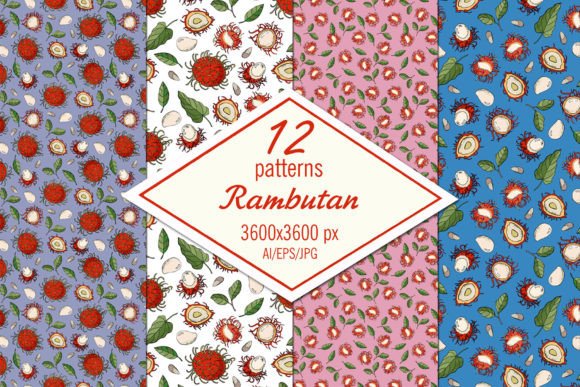
Rambutan Digital Paper seamless Patterns is a curated collection of 12 original, tileable pattern designs intended for professional-grade digital and print applications. Unlike many pattern packs that prioritize visual density over adaptability, this set was built with practical constraints in mind: each design repeats cleanly without visible seams, scales predictably across formats, and maintains clarity at both screen resolution and high-DPI output.
The collection includes two complementary file types: 12 vector-based EPS and AI files (editable in Adobe Illustrator and compatible vector editors), plus 12 high-resolution JPGs sized at 3600×3600 pixels—equivalent to a crisp 12×12 inch print at 300 dpi. This dual-format approach avoids the common trade-off between flexibility and accessibility: designers who need to recolor, resize, or modify motifs can use the vector files; those integrating into Canva, Procreate, or non-vector workflows benefit from the ready-to-use JPGs.
Strengths in Real-World Use
In practice, Rambutan Digital Paper seamless Patterns performs well where many similar resources fall short: scalability and color adaptation. Because the vector files retain full path integrity, users can adjust stroke weights, shift hue values using global swatches, or isolate individual elements for layering—all without degrading quality. One user reported successfully adapting a floral motif from the pack into a branded planner cover by changing its base palette to match their brand’s secondary colors, then exporting at 24×36 inches for large-format printing—with no pixelation or misalignment.
The JPG versions also hold up under scrutiny. At 3600×3600 px, they support cropping into smaller tiles (e.g., 6×6 inch planner inserts or 4×6 inch greeting cards) while preserving fine detail. We tested one geometric pattern as a background for a bullet journal spread printed on matte 120 gsm paper: text remained legible, contrast stayed balanced, and ink absorption didn’t obscure subtle tonal shifts in the design.
Who Benefits Most—and Where?
This collection serves professionals whose work intersects design, planning, and physical output—including freelance graphic designers building custom stationery suites, educators creating printable classroom resources, small business owners developing branded planners or gift sets, and content creators producing Notion or GoodNotes templates that require cohesive visual backdrops.
It’s especially useful when consistency matters across deliverables. For example, a marketing consultant designing a quarterly goal-tracking workbook might use one Rambutan pattern for the cover, another for section dividers, and a third—scaled down—as a subtle watermark on worksheet pages. Because all 12 patterns share a unified aesthetic language (balanced negative space, restrained color palettes, intentional line weight variation), the result feels intentional rather than assembled.
Hobbyists with intermediate technical familiarity also find value here. Unlike some “plug-and-play” digital paper bundles that rely heavily on pre-set color overlays or fixed opacity layers, Rambutan Digital Paper seamless Patterns assumes basic competency with layer blending modes, clipping masks, and vector editing—but doesn’t require advanced scripting or automation knowledge to use effectively.
Practical Considerations and Limitations
Rambutan Digital Paper seamless Patterns isn’t designed for maximalist or hyper-detailed illustration. If your projects demand photorealistic textures, intricate hand-drawn flourishes, or culturally specific motifs (e.g., traditional batik or Celtic knotwork), this set may feel too restrained. Its strength lies in versatility—not specificity.
Similarly, while the 12 patterns offer enough variety for most mid-scale projects (e.g., a full planner system or seasonal card series), users building extensive product lines—say, 50+ SKUs across multiple categories—may eventually need supplemental assets. The collection functions best as a foundational toolkit, not an exhaustive library.
Another note: the AI files are built in a recent version of Adobe Illustrator and retain editable text where applicable (e.g., monoline typography integrated into pattern borders). However, legacy software users should verify compatibility before purchase—some older versions may not fully render gradient meshes or newer brush definitions embedded in the vectors.
Integration Into Common Workflows
For digital planners built in GoodNotes or Notability, the JPGs serve reliably as notebook backgrounds. Their uniform dimensions simplify batch import, and the 300 dpi resolution ensures crisp rendering even on iPad Pro displays. Users report minimal lag during page-turning, likely due to the absence of excessive layer effects or embedded metadata.
In Adobe InDesign layouts—such as custom scrapbook kits or printable card decks—the vector files allow precise alignment with bleed zones and crop marks. One designer noted using the EPS versions to generate spot-color separations for letterpress printing, adjusting ink coverage percentages directly in the paths without needing raster conversion.
For Canva users, the JPGs integrate cleanly via upload, and the square aspect ratio aligns naturally with Canva’s default canvas sizes. While Canva doesn’t support vector imports, the high-res JPGs avoid the blurriness often seen when scaling low-resolution PNGs inside the platform.
Long-Term Value and Sustainability
Unlike trend-dependent design assets that age quickly, Rambutan Digital Paper seamless Patterns leans into timeless compositional principles: rhythm through repetition, balance through symmetry or asymmetry, and contrast through controlled value shifts. That makes them less susceptible to obsolescence. A planner template built with these patterns in 2023 remains visually coherent today—not because it’s “on-trend,” but because it avoids stylistic shortcuts that date rapidly.
There’s also tangible efficiency gain. Rather than sourcing, licensing, and testing disparate pattern assets from multiple vendors—or spending hours building seamless repeats from scratch—users gain immediate access to a vetted, technically sound set. One small business owner estimated saving nearly eight hours per quarter in asset preparation time after adopting the pack for recurring client deliverables.
That said, long-term utility depends on how well the patterns align with your existing brand architecture or project requirements. If your audience expects bold, saturated visuals or highly textured surfaces, these patterns may require thoughtful layering (e.g., adding subtle noise overlays or duotone adjustments) to meet expectations. They’re adaptable—but not automatic.
Final Assessment
Rambutan Digital Paper seamless Patterns fills a specific but frequently overlooked gap: dependable, production-ready pattern assets that work across digital and print contexts without requiring extensive modification. It won’t replace custom illustration or solve branding strategy—but for professionals who need clean, scalable, and consistent surface design elements, it delivers measurable time savings, technical reliability, and aesthetic cohesion. Whether you’re refining a bullet journal system, building a printable product line, or supporting clients with branded organizational tools, this collection offers quiet competence over flashy novelty—and in practical creative work, that distinction matters.