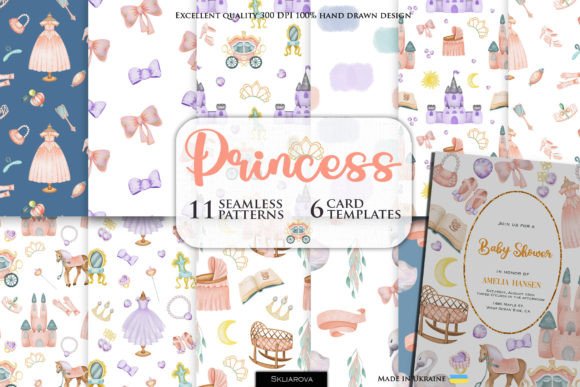
Princess Baby Shower Cards and Patterns: A Design Resource for Custom Celebrations
Creating a memorable baby shower—especially one with a regal, whimsical, or storybook-inspired theme—requires more than just charming decor and thoughtful gifts. It begins with visual identity: invitations that evoke wonder, printable decorations that feel cohesive, and personalized keepsakes that reflect care and intention. Princess Baby Shower Cards and Patterns is a carefully curated digital design resource built precisely for this purpose—not as a one-size-fits-all template pack, but as a flexible, production-ready toolkit for creators who value both aesthetic nuance and technical reliability.
What’s Inside the Collection—and Why Size and Format Matter
The set comprises two distinct yet complementary components: 11 seamless patterns and 6 versatile card templates. Each element is engineered for real-world use—not just visual appeal. Let’s unpack the specifications with practical context in mind.
The 11 seamless patterns are delivered as high-resolution JPEG files, each measuring 5000×5000 pixels—equivalent to approximately 16.6×16.6 inches (42×42 cm) at 300 dpi. This dimension isn’t arbitrary. At this scale, designers can confidently tile the pattern across large-format prints—think backdrop banners, custom wrapping paper, or fabric mockups—without visible repetition or pixelation. Because they’re JPEGs on a pure white background, they integrate effortlessly into layered designs in tools like Adobe Photoshop, Affinity Designer, or even Canva, without requiring manual background removal or blending mode adjustments.
The six card templates are sized to A4 (8.2×11.6 inches / 24.8×35.08 cm), a globally recognized standard used widely across Europe, Australia, and many print-on-demand services. Unlike letter-sized (8.5×11 inch) templates common in North America, A4 offers slightly more vertical space—ideal for longer guest lists, bilingual wording, or elegant typography treatments. All cards render at 300 dpi in RGB color mode, ensuring fidelity whether viewed on screen or professionally printed. The resolution supports crisp text, fine line work, and subtle gradients—critical when illustrating crowns, ribbons, tiaras, or delicate floral motifs associated with princess-themed celebrations.
Design Flexibility Through Scalability and Compatibility
A key advantage of this collection lies in its intentional scalability. All files—including both patterns and templates—are built to be reduced without loss of quality. That means a designer can scale a 5000×5000 px pattern down to fit a 2×2 inch digital sticker, a social media banner, or a monogrammed napkin motif—and retain clarity and detail. This isn’t merely about file format; it reflects an understanding of how modern creators actually work: across devices, platforms, and output types.
Consider a small business owner launching a boutique stationery line. They might use one pattern as the base for a series of matching thank-you cards, then repurpose a second as a watermark texture behind Instagram Stories announcing new arrivals. A freelance graphic designer preparing a client presentation could layer three patterns into a mood board showing cohesive theme development—from invitation suite to cake topper to photo booth backdrop. Meanwhile, an educator planning a classroom baby shower for a student teacher might adapt a card template for a printable “Wishes for the Baby” journal cover—then resize the same file for a projector slide during the event.
This level of reuse stems from deliberate technical choices: RGB color space (optimized for screen display and most consumer printers), JPEG compression balanced for fidelity over minimal file size, and consistent white-background treatment. There are no hidden layers, locked assets, or proprietary formats—just accessible, editable, and interoperable files.
Real-World Applications Across User Groups
Different users derive distinct value from the same resource—depending on their goals, tools, and constraints. Here’s how Princess Baby Shower Cards and Patterns functions across contexts:
- Small Business Owners & Print-on-Demand Sellers: Use the seamless patterns to create branded merchandise—tote bags, mugs, or onesies—with consistent princess-themed visuals. The A4 card templates serve as starting points for customizable listings on Etsy or Shopify, where buyers expect ready-to-print files.
- Educators & Community Organizers: Adapt templates for inclusive, low-cost event planning—adding school logos, multilingual instructions, or accessibility notes (e.g., larger font versions). Patterns can become part of classroom décor or visual aids for early literacy units centered on fairy tales or royalty themes.
- Hobbyists & DIY Families: Print cards at home on premium cardstock, cut them with precision scissors or a craft cutter, and pair them with handmade elements like pressed flowers or ribbon accents. The white background simplifies home printing—no need to adjust ink settings or worry about bleed zones.
- Graphic Design Students & Emerging Creatives: Study how cohesive visual language is constructed across scales and applications. Analyze spacing, hierarchy, and motif repetition in the templates; reverse-engineer tiling logic from the patterns; practice non-destructive editing techniques using these clean, well-structured assets.
Thoughtful Design Choices Behind the Aesthetic
The “princess” motif here avoids cliché through restraint and versatility. Rather than relying solely on cartoonish crowns or overt pink saturation, the illustrations incorporate soft watercolor textures, subtle gold foil suggestions (rendered in RGB for screen accuracy), and balanced negative space. This allows customization: a user can recolor a pattern’s accent tone to match nursery palettes—mint and ivory, lavender and charcoal, or even gender-neutral sage and cream—without altering structural integrity.
Each card template includes clearly marked safe zones and trim margins—essential for avoiding accidental cropping during printing. Typography is intentionally minimal and legible, leaving room for personalization without competing with decorative elements. That balance—between ornamental charm and functional clarity—is what makes the set adaptable rather than prescriptive.
Technical Considerations for Optimal Use
While the files are broadly compatible, optimal results depend on mindful usage. For example:
- When resizing JPEG patterns for web use (e.g., email headers or blog graphics), export at 72 dpi to reduce load time—but retain the original 5000×5000 px file for any future print needs.
- For professional offset printing, confirm with your vendor whether RGB-to-CMYK conversion is handled in-house. While RGB ensures screen accuracy, some commercial printers prefer CMYK files for color consistency—meaning minor hue shifts may occur if unmanaged.
- Because the templates are raster-based (not vector), avoid extreme enlargement beyond A4 dimensions unless necessary. For large-format signage, layer the seamless patterns instead of stretching the card layout itself.
Also worth noting: the absence of fonts in the templates is intentional. This avoids licensing complications and empowers users to choose typefaces aligned with their brand voice—whether that’s a graceful script for elegance, a clean sans-serif for modern simplicity, or a playful rounded font for toddler-friendly warmth.
Why This Approach Supports Ethical, Sustainable Design Practice
In an era where digital clutter multiplies faster than meaningful utility, resources like Princess Baby Shower Cards and Patterns model intentionality. There are no filler files, no upsold add-ons, no opaque licensing terms. Every included asset serves a documented function in the celebration lifecycle—from pre-event communication (invitations) to post-event sentiment (thank-you notes)—and does so with technical rigor.
That intentionality extends to sustainability. High-resolution, reusable files reduce the need for repeated downloads or redundant purchases. Designers can iterate locally—testing color variations, layout experiments, or accessibility enhancements—without reprocessing or re-exporting from external platforms. For educators and nonprofits operating under tight budgets, this means long-term access to polished materials without subscription fatigue or per-use fees.
Integration Into Broader Creative Workflows
These assets rarely exist in isolation. In practice, they become nodes in a larger workflow. A wedding planner expanding into baby events might combine one pattern with custom illustrations of baby animals wearing miniature crowns—then apply the same pattern to digital RSVP forms and physical escort cards. A researcher studying visual culture in early childhood rituals could use the templates as reference artifacts when analyzing how symbolism (crowns, stars, pastel palettes) conveys cultural values around innocence, protection, and aspiration.
Even in AI-assisted design, such collections retain relevance. While generative tools excel at ideation, they often falter on consistency, resolution control, and production-readiness. A human designer using Princess Baby Shower Cards and Patterns as foundational elements maintains full authorship over tone, proportion, and contextual appropriateness—guiding automation rather than outsourcing judgment.
Ultimately, this set succeeds not because it defines “princess” for everyone—but because it provides the calibrated tools to let each creator define it meaningfully, responsibly, and beautifully.