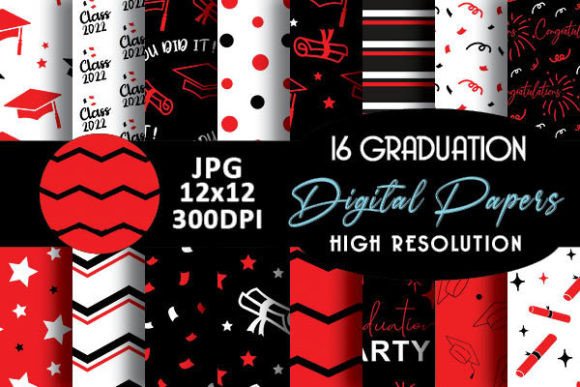
Red Black Graduation Digital Patterns: Practical Backgrounds for Purpose-Driven Design
Red Black Graduation Digital Patterns are a curated set of 16 high-resolution digital paper backgrounds—each featuring clean, scalable vector or raster-based designs centered on graduation motifs: tassels, mortarboards, diplomas, caps, laurel wreaths, and subtle geometric interpretations of academic achievement. Unlike generic clipart or low-res textures, these patterns are built for real-world use: consistent color fidelity (true red and black CMYK/RGB values), seamless tiling where appropriate, and intentional negative space for text overlay or photo integration. They’re not just decorative—they’re functional assets that slot into existing creative workflows without requiring redesign, color correction, or layout overhauls.
Where These Patterns Fit in Your Creative Process
These 16 Graduation digital papers function most effectively when treated as modular components—not standalone graphics, but foundational layers. In a typical project lifecycle, they serve distinct roles across phases:
- Before execution: Used in mood boards or client briefs to establish tone and thematic cohesion—especially helpful when pitching graduation-themed campaigns, school communications, or alumni outreach materials.
- During production: Applied directly as background layers in Canva, Adobe Photoshop, Illustrator, Affinity Designer, or even PowerPoint—no resizing or bleeding concerns thanks to their 300 DPI resolution and standard 12×12 inch or A4 dimensions.
- After delivery: Reused across related touchpoints—e.g., a printed invitation may share its background with the matching email header, social media banner, or thank-you card—ensuring visual continuity without redundant design time.
This phased utility means Red Black Graduation Digital Patterns reduce decision fatigue early and increase consistency late—two critical leverage points in time-constrained creative work.
Integration Across Tools and Teams
Compatibility is built in—not bolted on. All files arrive in widely supported formats: PNG (with transparent backgrounds where needed), JPG (for print-ready flat layers), and often PDF or SVG for vector flexibility. That means no plugin dependencies or format conversions before use. Designers drop them into Figma libraries; educators insert them into Google Slides templates; small business owners upload them directly to Mailchimp or Squarespace. Even non-designers benefit: the patterns require no graphic design skill to apply meaningfully—just drag, scale, and layer.
When working across teams, these backgrounds act as silent alignment tools. A marketing manager shares the same pattern file with a freelance designer and an in-house copywriter. Everyone references the same visual language—no misinterpretation of “academic red” or inconsistent tassel density. That shared asset reduces revision rounds and speeds up approval cycles, especially in education-adjacent sectors like tutoring services, college prep programs, or scholarship foundations.
Real-World Use Cases Beyond Invitations
While graduation invitations are the obvious fit, the practical strength of Red Black Graduation Digital Patterns lies in their adaptability to adjacent needs:
- Classroom resources: Teachers use them as printable worksheet headers, certificate backgrounds, or bulletin board accents—reinforcing achievement visually without extra printing costs.
- Small business branding: Tutoring centers or test prep studios incorporate the patterns into branded slide decks, progress report covers, or digital badges—creating recognition without full rebranding.
- Content creation: Bloggers and educators build Pinterest pins or Instagram carousels using one pattern per slide, maintaining rhythm and professionalism across posts about study tips, cap-and-gown shopping guides, or commencement speech advice.
- Event planning: Coordinators apply patterns to digital signage, Zoom virtual backgrounds, or printed name tags—keeping physical and virtual environments aligned during hybrid ceremonies.
The key is treating each of the 16 Graduation digital papers as a reusable system element—not a one-off decoration. One pattern might anchor your main announcement; another, with bolder tassel repetition, works better for social media thumbnails; a third, with minimal cap icons and ample white space, suits formal certificates. Variation is intentional, not arbitrary.
Workflow Tips for Consistent, Efficient Use
To maximize longevity and minimize friction, integrate these patterns with simple organizational habits:
- Name files descriptively—not “pattern_03.jpg” but “red-black-tassel-dense-300dpi.jpg”. This saves seconds per search and avoids accidental duplication.
- Store them in a dedicated, synced folder—Google Drive, Dropbox, or your team’s shared asset library—with clear read-only permissions for contributors who need access but shouldn’t edit source files.
- Create template shortcuts: Save a base Canva or PowerPoint file with each pattern pre-loaded as a background layer. When starting a new project, duplicate the template instead of hunting for the right file.
- Use color overlays sparingly: Since red and black are already optimized for contrast and accessibility, avoid adding filters or tint layers unless absolutely necessary for branding alignment.
Also consider output context early. For print projects, verify bleed settings match your printer’s requirements—most of these patterns include safe margins, but always check. For digital use, compress final exports separately (e.g., via TinyPNG) rather than downscaling the original asset—preserving quality for future reuse.
Long-Term Value and Quality Control
These aren’t disposable graphics. Because they’re resolution-independent in vector variants and carefully calibrated in raster versions, they remain viable across evolving platforms—from legacy LMS interfaces to emerging AR graduation announcements. Their longevity comes from restraint: no trendy gradients, no dated fonts embedded in the pattern, no proprietary effects. Just purpose-built, academically resonant visuals.
Quality control starts with selection. When choosing which of the 16 Graduation digital papers to use for a given task, ask two questions: Does this support legibility? Does it reinforce intent? A dense tassel repeat may energize a party flyer but overwhelm a formal diploma. A subtle cap dot pattern adds texture to a newsletter without competing with body text. That discernment—paired with consistent application—builds trust through visual reliability.
Over time, users often find themselves reaching for the same three or four patterns repeatedly—not out of habit, but because those align most closely with their audience’s expectations and their own production standards. That’s efficiency earned, not assumed.
Getting Started Without Overhead
You don’t need a design system overhaul to begin. Start with one recurring need: maybe weekly student recognition emails, monthly alumni newsletters, or annual open house handouts. Assign one Red Black Graduation Digital Pattern to that use case. Apply it consistently for three months. Track how much faster layouts come together—or how often recipients comment on the polished look. Then expand to a second use case. Integration compounds quietly: each added context reinforces the pattern’s utility without demanding new learning curves or software changes.
What makes Red Black Graduation Digital Patterns durable isn’t novelty—it’s precision. They meet a narrow, well-defined need with no excess. That focus translates directly into time saved, consistency gained, and communication sharpened—whether you’re launching a micro-business, managing a school PTA, or designing for a national university campaign.