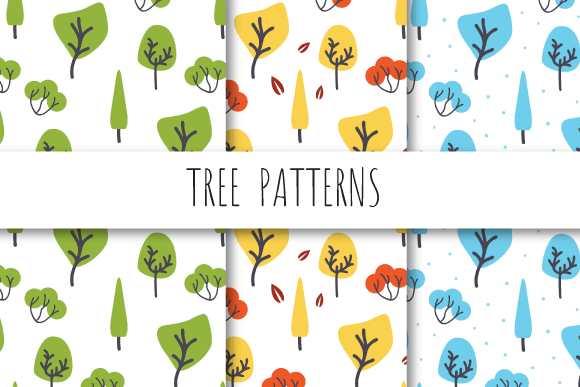
Tree Patterns: Seamless Vector Designs for Professional Print and Digital Use
Tree Patterns refer to a specific category of vector-based, tileable artwork designed to replicate natural arboreal forms—branches, leaves, silhouettes, or abstracted botanical motifs—in a way that repeats flawlessly across any surface. Unlike static illustrations or raster-based textures, Tree Patterns are built as mathematically precise, infinitely scalable EPS files, optimized for high-resolution output. Each pattern in this collection measures 12 × 12 inches at 300 dpi (3600 × 3600 pixels), ensuring crisp fidelity whether printed on wallpaper, fabric, packaging, or large-format signage—or repurposed digitally for web backgrounds, UI overlays, or motion graphics assets.
What Makes Tree Patterns Distinctive?
The defining trait of Tree Patterns is their dual focus on organic authenticity and technical precision. These aren’t stylized clipart or generically algorithmic fractals—they’re hand-crafted vector compositions where branch angles, leaf density, and negative space are calibrated to avoid visual fatigue during repetition. The seamlessness isn’t just about edge alignment; it’s about rhythm. A well-designed Tree Pattern guides the eye across repeated tiles without revealing a “join,” even under close inspection or at extreme zoom levels.
This level of control stems from how each pattern is constructed in Adobe Illustrator using native vector tools—not traced raster images or auto-tiling plugins. Paths are simplified but not oversimplified; anchor points are minimized without sacrificing nuance in tapering stems or layered foliage. That craftsmanship directly impacts usability: designers can recolor individual elements non-destructively, isolate components for custom edits, or scale the entire pattern up to billboard size with zero pixelation.
How Tree Patterns Compare with Other Repeat Options
When evaluating repeat patterns, users often encounter three broad categories: raster-based seamless tiles, procedural or AI-generated repeats, and hand-drawn vector patterns like Tree Patterns. Each has tradeoffs rooted in resolution limits, editability, and aesthetic intention.
- Raster-based repeats (e.g., JPEG or PNG tiles) are widely accessible and easy to preview, but they’re resolution-bound. At 3600 × 3600 pixels, these files hold up well for standard print—but stretching beyond 12 × 12 inches risks visible interpolation or softening. They also resist color adjustments without quality loss, since every edit requires reprocessing the full bitmap.
- Procedural or AI-generated repeats offer speed and variation, but often lack intentional hierarchy or botanical plausibility. Branch intersections may feel arbitrary, leaf clusters overly uniform, or scaling inconsistent across iterations. These tools excel for rapid prototyping or mood boards—but rarely meet production-grade requirements for brand consistency or tactile print fidelity.
- Hand-crafted vector repeats like Tree Patterns prioritize human judgment over algorithmic efficiency. The designer makes deliberate choices about weight distribution, directional flow, and spatial breathing—factors that affect how a pattern feels when applied to curved surfaces, textiles, or irregular substrates. That intentionality translates into reliability across use cases, especially where physical output is involved.
Strengths and Practical Fit
Tree Patterns shine in scenarios demanding both aesthetic cohesion and technical robustness. Interior designers selecting wallpaper for a boutique hotel might choose a subtle olive-branch motif because its gentle repetition supports spatial calm without monotony—and because the EPS format allows precise registration during commercial printing. Similarly, a packaging team developing eco-conscious product labels could adapt a birch-silhouette pattern across multiple SKUs, changing only the base color while preserving structural integrity across die-cut shapes and foil-stamping layers.
The inclusion of both EPS and JPEG versions in the ZIP file adds flexibility. The EPS files serve as the master source—editable, scalable, and CMYK-ready. The JPEGs provide immediate preview capability, accurate color representation for client approvals, and fallback options for platforms that don’t support vector uploads (e.g., certain CMS themes or social media ad builders). Having both formats means no compromise between creative control and workflow pragmatism.
Where Tree Patterns Excel
- High-fidelity print applications: Book covers, stationery suites, textile design, and wall murals benefit from the 300 dpi native resolution and vector scalability.
- Brand-aligned customization: Because paths remain editable, designers can adjust stroke weights, merge layers, or extract single elements to build complementary icons or secondary graphics—keeping visual language unified.
- Cross-medium consistency: A single Tree Pattern can appear identically on a business card, website hero section, and exhibition banner—no need to manage separate assets for each context.
Limitations and Decision Factors
Tree Patterns aren’t universally optimal. Their strength in precision comes with constraints worth acknowledging. First, they require vector-capable software (Illustrator, Affinity Designer, CorelDRAW) for full editing access. Users relying solely on raster editors like Photoshop or free online tools will be limited to using the JPEGs as-is—losing scalability and color-editing flexibility.
Second, the style is intentionally restrained. These aren’t bold, graphic-heavy patterns meant for maximal visual impact. If your project calls for exaggerated scale, dramatic contrast, or illustrative storytelling (e.g., a children’s book cover featuring a single expressive oak), a bespoke illustration may serve better than a repeating motif—even a beautifully executed one.
Third, while the three included patterns offer variety—say, a minimalist ash-line variant, a layered maple canopy, and a sparse winter-bare composition—they represent a curated subset. Users needing dozens of variations, seasonal adaptations, or region-specific species (e.g., eucalyptus for Australian branding) would need to commission additional work or supplement with other resources.
When to Choose Tree Patterns—and When to Look Elsewhere
Tree Patterns are a strong fit if you value predictability, professional output standards, and long-term asset reuse. They suit projects where repetition must feel intentional—not mechanical—and where the final medium includes physical print. Think architectural renderings with coordinated surface treatments, sustainable product lines emphasizing natural materials, or editorial layouts seeking quiet sophistication over visual noise.
They’re less suited for time-sensitive social media campaigns requiring rapid iteration across 10+ aspect ratios, or for developers integrating dynamic, responsive backgrounds where SVG-in-CSS solutions offer lighter file sizes and real-time manipulation. Likewise, educators building classroom visuals may find royalty-free photo-based tree textures more intuitive for quick assembly—especially if vector editing skills aren’t part of their workflow.
It’s also worth noting that “seamless” doesn’t mean “invisible.” A Tree Pattern’s effectiveness depends on context: a dense fern motif may overwhelm small UI elements but ground a spacious landing page. Previewing at actual size—and testing across intended outputs—is more valuable than assuming a pattern will “just work” everywhere.
Making an Informed Choice
Before acquiring Tree Patterns—or any repeat resource—consider your primary output channel, editing needs, and aesthetic goals. Ask: Will this live mostly on screen or in print? Do I need to modify colors, spacing, or components post-purchase? Does the pattern’s rhythm complement, rather than compete with, surrounding typography or imagery?
Compare sample previews at 100% zoom—not thumbnail views—to assess line clarity and repetition subtlety. Check whether the JPEGs match the EPS color rendering (some conversions shift saturation or contrast). And verify that your software supports EPS 10—the version used here ensures compatibility with Illustrator CS6 through current releases, avoiding legacy import issues.
Ultimately, Tree Patterns represent a considered intersection of botanical reference and vector discipline. They won’t replace custom illustration, nor do they aim to. Instead, they fill a practical niche: delivering reliable, elegant, production-ready repetition for professionals who understand that how a pattern behaves matters as much as how it looks.