Ugly Christmas Sweater Knitting Patterns: A Creative Catalyst for Designers, Makers, and Educators
Ugly Christmas Sweater Knitting Patterns sit at a fascinating intersection of craft tradition and contemporary visual culture. Far more than kitschy novelties, these patterns represent a dynamic design language—one that blends nostalgia, humor, tactile texture, and bold graphic sensibility. When paired with curated Ugly Christmas Sweater Patterns, Background Textures, and the comprehensive Ugly Christmas Sweater Patterns Bundle, they become powerful tools for professionals and hobbyists alike. This synergy transforms abstract holiday cheer into tangible, reusable, high-fidelity assets—especially when working with digital-first workflows.
From Needle to Pixel: How Knitting Patterns Inform Digital Design Systems
At first glance, Ugly Christmas Sweater Knitting Patterns may seem strictly analog—rows of stitches, color changes every few needles, intarsia charts mapping reindeer antlers or tinsel-draped snowmen. But their underlying structure is deeply systematic: repeatable motifs, modular grids, rhythmic color transitions, and deliberate visual contrast. These are precisely the principles that translate seamlessly into digital pattern design. Each stitch becomes a pixel; each row, a horizontal band of texture; each motif, a scalable vector-ready shape.
For example, a classic “candy cane stripe” knitting pattern—alternating red and white vertical bands—maps directly to a seamless Ugly Christmas Sweater Background Bundle tile. Likewise, a complex 12-row chart depicting a winking snowman with pom-pom hat yields a rich, layered Ugly Christmas Sweater Textures Bundle JPEG when rendered at 300 DPI and 4500x5400 pixels. That resolution isn’t arbitrary: it ensures crisp output whether printed on fabric yardage, embossed on greeting cards, or scaled across a 4K social media banner.
The Practical Power of the Ugly Christmas Sweater Patterns Bundle
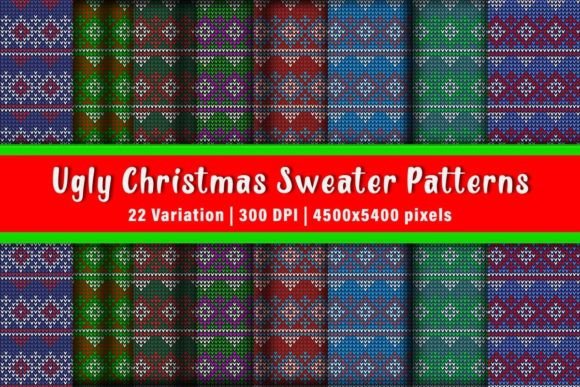
The Ugly Christmas Sweater Patterns Bundle isn’t just a collection—it’s a workflow accelerator. Comprising 22 high-resolution JPEG digital papers, each file delivers professional-grade versatility:
- Consistent technical specs: All files are 300 DPI and sized at 4500×5400 pixels—large enough to fill full-page print layouts without interpolation artifacts, yet optimized for fast loading in design software like Adobe Photoshop, Affinity Designer, or Canva Pro.
- Texture-rich fidelity: Unlike flat vector fills, these JPEGs retain subtle grain, knit-loop variation, and yarn-level depth—critical when simulating real sweater surfaces for mockups or textile design.
- Seamless tiling capability: Many patterns are constructed with edge alignment in mind, allowing designers to create infinite backgrounds for websites, presentation decks, or printable wrapping paper without visible seams.
This bundle bridges disciplines. A fashion student developing a holiday capsule collection can overlay a knit-inspired texture onto a garment flat sketch. A small-batch apparel brand can apply the same pattern as a sublimation print base for actual sweaters. A K–12 art teacher might project a large-scale version onto butcher paper for collaborative mural painting—turning pattern recognition into a cross-curricular exercise in symmetry, repetition, and cultural symbolism.
Real-World Applications Across Sectors
The adaptability of Ugly Christmas Sweater Patterns and related assets extends well beyond seasonal novelty. Their utility emerges most clearly in context-specific implementation:
Graphic Design & Branding
Design agencies frequently leverage these textures to add warmth and approachability to corporate holiday campaigns. A financial services firm might use a low-saturation, geometric sweater pattern (think interlocking holly leaves) as a subtle background for an end-of-year client newsletter—conveying celebration without sacrificing professionalism. The Ugly Christmas Sweater Background Bundle offers exactly this range: from maximalist candy-cane chaos to minimalist Nordic zigzags.
Educational Tools & Maker Literacy
In makerspaces and STEAM classrooms, Ugly Christmas Sweater Knitting Patterns serve as accessible entry points into computational thinking. Students decode chart symbols, identify repeating sequences, and predict outcomes—skills directly transferable to coding logic and algorithmic design. When digitized, those same charts become editable layers in design software, enabling remix culture: swapping colors, mirroring motifs, or isolating elements for laser-cut stencils.
Print Production & Craft Entrepreneurship
Small business owners selling handmade goods rely heavily on consistency and scalability. With the Ugly Christmas Sweater Textures Bundle, a ceramicist can wrap mug designs in coordinated sweater-patterned gift boxes. A stationery maker can generate matching notecard sets, envelope liners, and sticker sheets—all using identical base textures. No need to recreate motifs from scratch; instead, adjust hue, opacity, or blending mode to achieve cohesive product families.
Digital Experience Design
Web developers and UX designers integrate these backgrounds into festive landing pages, email headers, or interactive advent calendars. Because each JPEG is 4500×5400 pixels, responsive CSS can crop or zoom intelligently across device sizes. A background showing oversized baubles and tangled lights reads beautifully on desktop while gracefully simplifying to a single repeating ornament on mobile—preserving intent without compromising performance.
Why Resolution and Format Matter More Than You Think
Not all “Christmas patterns” are created equal. Free web downloads often max out at 72 DPI and 1200×1600 pixels—fine for screen-only use but disastrous for print. Blurriness, jagged edges, and color banding appear instantly when scaled. In contrast, the technical rigor behind the Ugly Christmas Sweater Patterns Bundle reflects deep understanding of production pipelines.
Consider a local print shop preparing custom invitations for a holiday gala. They require CMYK-ready, bleed-inclusive files at minimum 300 DPI. A 4500×5400 JPEG fits standard 8.5″×11″ layouts with room for trim and bleed—and even accommodates larger formats like 12″×18″ posters. Similarly, embroidery digitizers converting sweater motifs into stitch files benefit from high-res source material: clean edges mean accurate vector tracing, which translates to precise thread placement on fabric.
Thoughtful Integration Over Trend Chasing
While “ugly” implies irreverence, successful application hinges on intentionality—not randomness. A cluttered background overwhelms body text in a newsletter. A hyper-saturated texture competes with product photography on an e-commerce site. The most effective uses balance visual energy with functional clarity.
Best practices include:
- Layering with purpose: Use a subtle knit texture as a base layer beneath semi-transparent typography—not competing with, but enhancing, legibility.
- Color harmonization: Adjust hue/saturation in editing software to align with existing brand palettes. A mustard-and-navy sweater pattern can be desaturated and warmed to complement earth-toned packaging.
- Motif isolation: Extract individual elements (e.g., a single snowflake or present icon) from a full-pattern JPEG using selection tools—then repurpose them as standalone graphics for social posts or app icons.
Expanding Beyond the Obvious: Unexpected Cross-Applications
These resources also support less intuitive but highly valuable uses. Therapists incorporate textured visuals into sensory regulation activities for neurodiverse clients—predictable, rhythmic patterns provide calming input. Urban planners have used sweater-inspired color-blocking in community engagement materials to make zoning maps feel more inviting. Even data visualization specialists have adapted knit-grid logic to represent seasonal sales fluctuations—mapping rows of stitches to monthly metrics, with color intensity reflecting revenue variance.
What unites these diverse applications is a shared reliance on structure, recognizability, and emotional resonance. An Ugly Christmas Sweater Knitting Pattern isn’t merely decorative—it’s a scaffold. It invites participation, encourages reinterpretation, and carries cultural weight without demanding uniformity.
Choosing With Purpose
When selecting among Ugly Christmas Sweater Patterns, consider not just aesthetic preference but functional longevity. Does the pattern scale cleanly? Does it contain enough visual hierarchy to support overlays? Is its contrast suitable for both light and dark mode interfaces? Bundles that include varied densities—tight argyle, loose cable-knit, open lace-inspired weaves—offer maximum flexibility across projects.
Ultimately, these assets succeed because they honor craft while embracing digital fluency. They don’t ask users to choose between handmade authenticity and modern efficiency. Instead, they deliver both—woven together, row by row, pixel by pixel.