Unique Patterns: Elevating Creative Workflows with Purpose-Built Design Assets
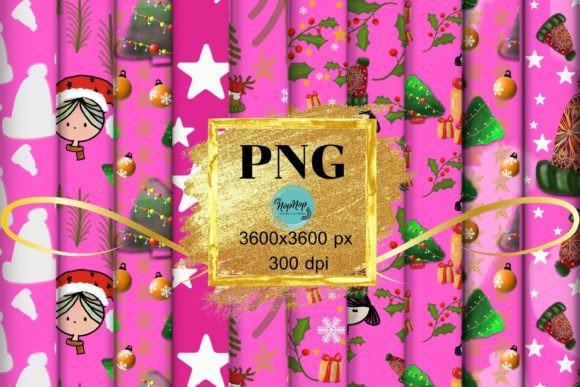
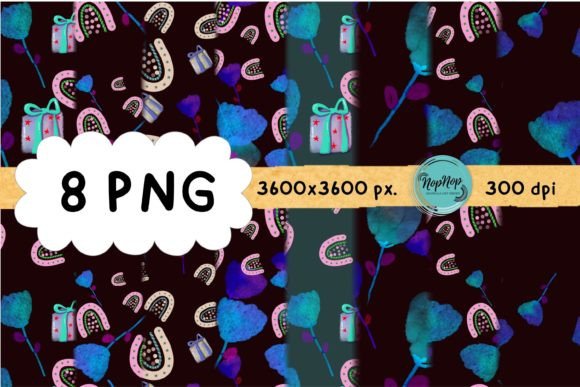
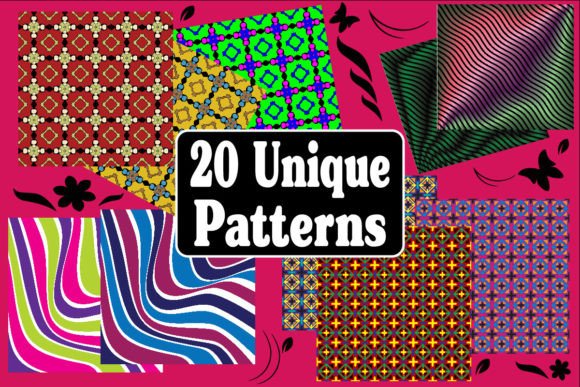
In today’s saturated digital landscape—where attention is fragmented, authenticity is currency, and speed-to-market defines competitive advantage—creative professionals are rethinking how they source, adapt, and deploy visual assets. Unique Patterns isn’t just another pack of decorative papers. It’s a precision-crafted toolkit designed for creators who demand both aesthetic distinction and operational efficiency. Comprising 20 thoughtfully composed pattern designs—each delivered as high-resolution PNGs (3600 × 3600 pixels, 300 DPI, 12×12 inches)—this collection bridges the gap between expressive originality and scalable production readiness.
What Sets Unique Patterns Apart From Generic Design Resources
Not all pattern libraries are built with intention. Many rely on algorithmic repetition, overused motifs, or stylistic homogeneity that blends into the background rather than standing out. Unique Patterns breaks from that cycle by prioritizing contextual versatility and visual integrity. Each of the 20 patterns was developed using distinct compositional logic—ranging from organic watercolor grain overlays to geometric tessellations with subtle asymmetry, hand-drawn botanical linework with intentional negative space, and minimalist tonal gradients calibrated for print fidelity.
This isn’t about filling space—it’s about reinforcing message, mood, and brand voice. A wedding invitation designer might layer a delicate gold-foil-inspired lattice pattern beneath elegant serif typography to evoke heritage and refinement. A SaaS marketer could integrate a clean, low-contrast grid variant into an email header to suggest structure and trust without visual noise. An educator creating printable learning kits might select a playful, scale-varied dot motif that remains legible when reduced to 20% size on a laminated flashcard.
Aligning With Evolving Creative and Business Realities
The rise of Unique Patterns reflects broader shifts across creative industries:
- Democratized production tools—from Canva to Figma to Adobe Express—have lowered technical barriers but raised expectations for visual differentiation. Users no longer settle for “good enough” backgrounds; they seek assets that signal professionalism and care.
- Hybrid workflows are now standard: designers move fluidly between print collateral, social media graphics, email templates, and physical product packaging. Assets must perform consistently across formats—and Unique Patterns delivers at true 300 DPI, eliminating pixelation in printed invitations while scaling flawlessly for Instagram carousels or PDF-based course workbooks.
- Brand consistency at scale demands reusable, modular elements. Rather than commissioning custom illustrations for every campaign, savvy freelancers and small studios use curated pattern sets like Unique Patterns as foundational texture layers—applying them as overlays, clipping masks, or seamless tile backgrounds to unify disparate assets under a single visual language.
- Consumer fatigue with AI-generated uniformity is growing. Audiences increasingly respond to design choices that feel human-scaled: slight irregularities in line weight, nuanced tonal transitions, and rhythmic variations that echo natural systems—not machine-perfect symmetry. All 20 patterns in this collection were reviewed for tactile resonance and perceptual warmth, avoiding sterile repetition.
Practical Integration Across Professional Domains
For entrepreneurs and solopreneurs, time is non-renewable. Unique Patterns shortens the path from concept to client-ready deliverable. Consider a boutique branding consultant preparing a mood board for a sustainable skincare launch: instead of spending hours sourcing and editing textures, she applies Pattern #7—a soft, biodegradable-paper-inspired grain—as a subtle base layer behind product mockups, instantly communicating eco-consciousness through materiality—not just messaging.
Freelance graphic designers benefit from the collection’s technical discipline. Each PNG includes transparent backgrounds and true CMYK-safe color profiles, reducing prepress troubleshooting. When designing a limited-edition event poster for a jazz festival, a designer can composite Pattern #14—a dynamic, brass-instrument-inspired waveform motif—into the background using multiply blend mode, letting typography remain crisp while adding kinetic energy.
Marketers and content creators leverage these patterns to strengthen visual hierarchy in digital spaces. A LinkedIn carousel post explaining data storytelling principles uses Pattern #3—a muted, data-point-inspired dot matrix—as a consistent footer bar across slides. The repetition builds recognition; the subtlety avoids distraction. Likewise, an Etsy seller of handmade ceramics uses Pattern #19—a matte clay-texture overlay—to unify her shop banner, product listing backgrounds, and packaging inserts—creating a cohesive unboxing experience that reinforces artisanal value.
Even educators and nonprofit communicators find utility. A literacy nonprofit designing bilingual reading guides applies Pattern #11—a gentle, interlocking leaf motif—to section dividers, visually cueing transitions between phonics exercises and comprehension questions—supporting cognitive processing without overwhelming young readers.
Why Resolution, Format, and Context Matter More Than Ever
It’s not hyperbole to say that asset quality directly impacts perceived credibility. A 72 DPI JPEG stretched across a trade show banner will betray its origins before a prospect reads the first word. Conversely, the 3600 × 3600 pixel dimensions and 300 DPI resolution of each Unique Patterns file ensure fidelity whether outputting to letterpress stationery, large-format vinyl wraps, or retina-display web banners.
The PNG format—with alpha transparency support—enables immediate integration into layered design files. No need to remove white backgrounds or adjust blending modes manually. This eliminates friction in collaborative environments where marketers, designers, and developers share Figma or Adobe XD files. It also supports accessibility best practices: because patterns are non-essential decorative elements, they can be safely omitted from screen reader contexts without compromising content structure.
Looking Ahead: Patterns as Strategic Infrastructure
As generative AI accelerates asset creation, the value proposition of intentionally designed, human-curated resources like Unique Patterns grows—not diminishes. Algorithms excel at variation, but struggle with contextual nuance: knowing when a pattern should recede versus anchor, when opacity enhances legibility versus obscures meaning, or how cultural associations influence motif reception across global audiences.
This collection represents a shift from viewing patterns as ornamental afterthoughts to treating them as strategic infrastructure—reusable, brand-aligned, technically robust components that accelerate execution without sacrificing intentionality. That’s why professionals across disciplines—from UX designers building component libraries to indie publishers crafting limited-run zines—are moving toward modular, purpose-built asset systems. Unique Patterns fits precisely within that evolution.
A Final Note on Community and Continuity
Creative work thrives on feedback loops and shared momentum. If you’ve integrated Unique Patterns into your process—whether to elevate a client presentation, streamline your print-on-demand offerings, or add tactile depth to a personal art series—we invite you to share your experience. Leave a review to help fellow creators assess fit and functionality. And if you appreciate the rigor behind these 20 designs—the attention to scale, resolution, tonal balance, and cross-medium adaptability—follow our page for upcoming releases. Future collections will expand into coordinated color systems, editable vector variants, and pattern + typography pairings—all grounded in the same principle: empowering professionals to create with clarity, confidence, and craft.
Your workflow shouldn’t be slowed by compromise. With Unique Patterns, distinction isn’t added later—it’s built in from the first pixel.